



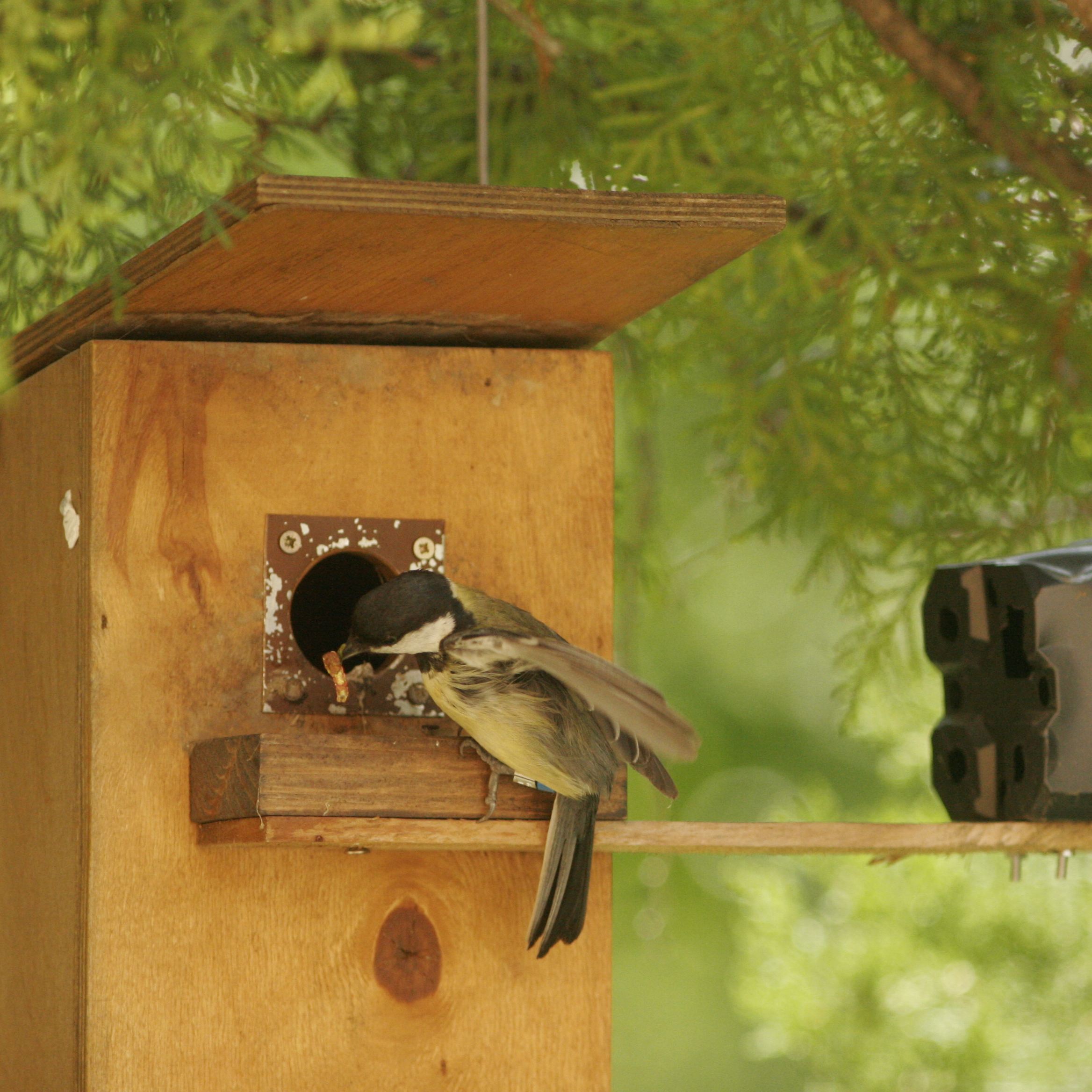
The research group, founded in 2004, focuses on environmental factors regulating urban animal populations and the behavioral and evolutionary consequences of habitat urbanization. Through studies on wild populations and laboratory experiments, they have identified differences in fear responses to humans between urban and forest birds. By examining brain receptor genes, they investigate the genetic basis of behavioral diversity. For over a decade, they have been monitoring the breeding success and survival of urban birds and mapping their habitat use through individual telemetry tracking. Their results have shown that urban areas create unfavorable feeding conditions for some bird species, reducing their breeding success.
In another major area of research, they study the evolution of the reproductive systems of vertebrate animals. Using phylogenetic comparative methods, they examine the environmental and social factors causing changes in mating and parental care behavior among species. They were the first to demonstrate that the evolution of reproductive behavior is related to species-specific adult sex ratios, and that the latter can be influenced in part by chromosomes determining sex. In one of their latest projects, they investigate, through field research on Asian leaf warblers, the ecological and demographic factors that may explain the evolution of species-specific reversed sex roles (female competition, male parental care).
The research group is involved in a large-scale nature conservation project supported by the European Union LIFE program, aiming to restore the ecological balance of one of Hungary's most characteristic salt marsh-wetland complexes (Miklapuszta, Kiskunsági National Park).



RESEARCH GROUP LEADER
Dr. András Liker
University professor
Contact

Services and infrastructure

Monitoring the size and breeding success of bird populations
Center for Natural Sciences | Behavioral Ecology Research Group
Research field: Urban ecology, behavioral biology, evolution, reproductive systems, birds
Point and transect-based bird population surveys; locating and monitoring nests, determining reproductive success; trend estimation based on long-term datasets; individual bird marking; data collection using nest cameras; survival estimation based on mark-recapture.
Measurement of habitat-urbanization effects
Center for Natural Sciences | Behavioral Ecology Research Group
Research field: Urban ecology, behavioral biology, evolution, reproductive systems, birds
Determining urbanization based on built-up areas and green spaces from satellite images; estimating and verifying vegetation cover through field surveys; assessing disturbances associated with human presence; estimating arboreal insect biomass through "frassfall" sampling; estimating the climatic effects on bird nesting biology using statistical models.

Partners
- University of Bath, United Kingdom
- University of Sheffield, United Kingdom
- Khon Kaen University, Thailand
- Állatorvostudományi Egyetem, Budapest
- Semmelweis Egyetem, Budapest
- ELKH Ökológiai Kutatóközpont, Budapest

Publications
- Pipoly I., Mészáros G., Bókony V., Vági B., Székely T., Liker A. (2023) Multiple paternity is related to adult sex ratio and sex determination system in reptiles. Journal of Evolutionary Ecology 36: 935–944
- Seress G., Sándor K., Evans K.L., Liker A. (2020) Food availability limits avian reproduction in the city: An experimental study on great tits Parus major. Journal of Animal Ecology 89: 1570-1580.
- Pipoly I., Bókony V., Kirkpatrick M., Donald P. F., Székely T., & Liker A. (2015) The genetic sex-determination system predicts adult sex ratios in tetrapods. Nature 527: 91-94.
- Liker A., Freckleton R.P. & Székely T. (2013) The evolution of sex roles in birds is related to adult sex ratio. Nature Communications 4: Article number 1587.