



The institute is engaged in intensive research on various membrane separation techniques, improving the efficiency of biotechnological processes, and renewable, green energy production, involving VMADI PhD students. The tasks of the Bioengineering, Membrane Technology, and Energy Research Group include:
- educating bioengineering students (supervision),
- introducing a wide range of biochemical and biotechnological processes, and
- introducing engineering students to the world of membranes and their applications.
Bioelectrochemical systems (BES):
Within BES, the simplest devices are microbial fuel cells (MFCs). These are bioelectrochemical devices in which microorganisms oxidize organic matter to produce electricity. Microorganisms living in the anode compartment release electrons during oxidation, which migrate to the cathode, creating an electric current. These microbial cells are capable of directly producing electrical current from biomass, thus generating renewable "bio" energy with completely waste-free and environmentally friendly processes.
Biohydrogen:
The biological production of hydrogen is currently one of the most popular areas in bioenergy, as hydrogen, due to its environmentally friendly characteristics and high energy content, can play a crucial role in shaping the sustainable development of the future. However, biohydrogen technology still needs further development, and questions regarding production and purification are among the most essential. In recent years, our group has gained significant experience in these two areas, focusing mainly on the production of biohydrogen through photo- and dark fermentation (using various microorganisms such as Thiocapsa roseopersicina, Thermococcus litoralis, Escherichia coli), as well as the purification of the produced gas using membrane techniques (polymer and ionic liquid membranes).


RESEARCH GROUP LEADER
Dr. Katalin Bélafiné Bakó
University professor
Contact

Services and Infrastructure

Electrochemical measurement systems
Research Centre for Biochemical, Environmental and Chemical Engineering | Research Group on Bioengineering, Membrane Technology and Energetic
Research field: Bioelectrochemical cells, integrated systems, gas separation, membranes
- PalmSens3: potentiostat, galvanostat, electrochemical impedance spectroscopy
- EmStat3 (PalmSens3): potentiostat, galvanostat
- Ivium Vertex One (4-electrode): potentiostat, galvanostat, electrochemical impedance spectroscopy
The potentiostat/galvanostat equipment allows for various electrochemical measurements (e.g., polarization, electrochemical impedance, chronoamperometry, chronopotentiometry, linear sweep voltammetry, cyclic voltammetry, etc.). They are essential for applications such as studying ion exchange membranes, electrochemically active materials (e.g., catalyst layers), and electrochemical cells (e.g., electrolysis cells, microbial electrochemical cells).

Spectrophotometers
Research Centre for Biochemical, Environmental and Chemical Engineering | Research Group on Bioengineering, Membrane Technology and Energetic
Research field: Bioelectrochemical cells, integrated systems, gas separation, membranes
- Shimadzu UV-1800
- Hach DR3900 VIS
Our spectrophotometric devices are suitable for the quantitative determination of various components in both the visible and UV ranges.

Rotary vacuum evaporators
Research Centre for Biochemical, Environmental and Chemical Engineering | Research Group on Bioengineering, Membrane Technology and Energetic
Research field: Bioelectrochemical cells, integrated systems, gas separation, membranes
- Heidolph VV2000 vacuum evaporator
The device is suitable for routine vacuum evaporation operations with a maximum capacity of 4 liters.
Tools for sterile work
Research Centre for Biochemical, Environmental and Chemical Engineering | Research Group on Bioengineering, Membrane Technology and Energetic
Research field: Bioelectrochemical cells, integrated systems, gas separation, membranes
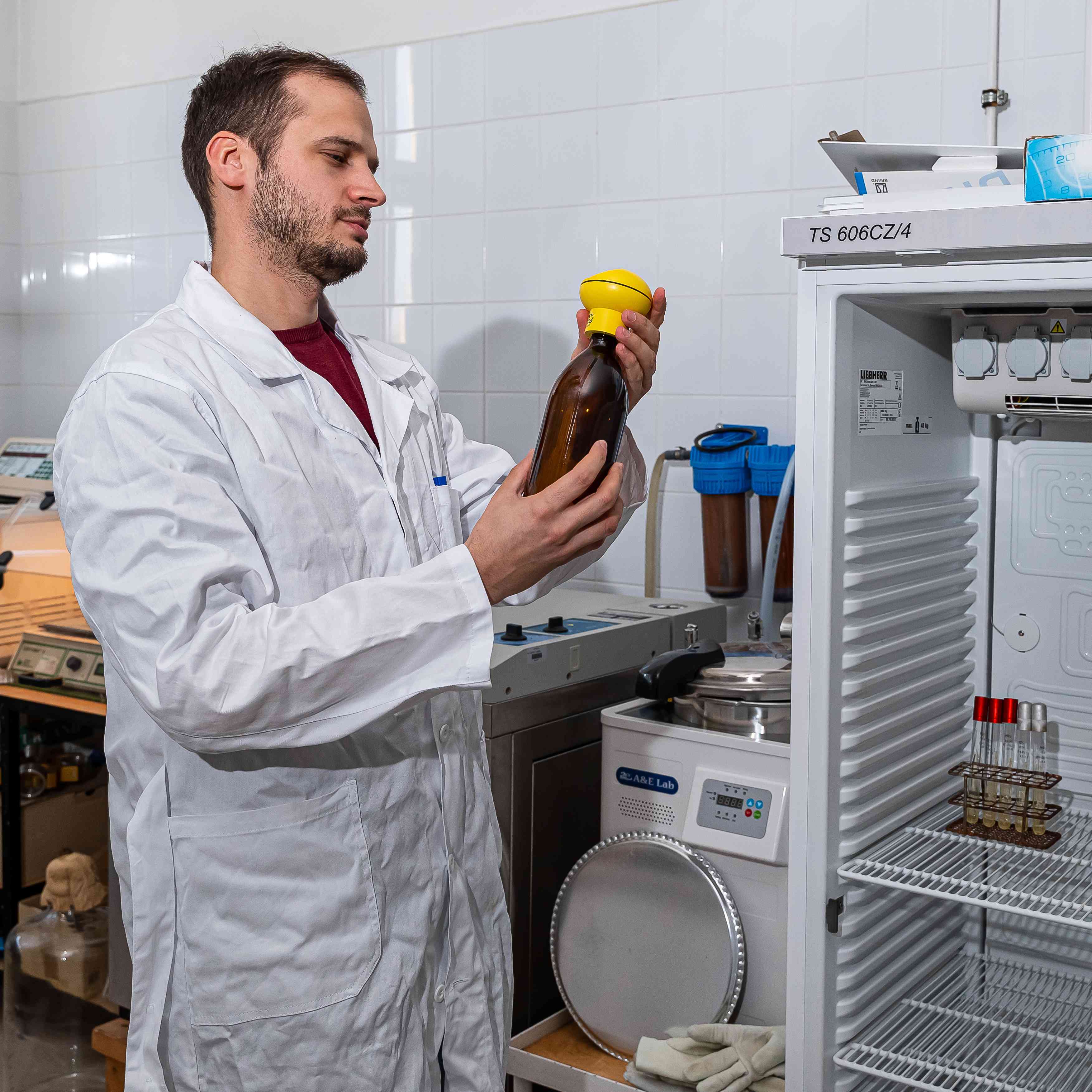
- BA-900 laminar box
- Tuttnauer 5050 MLV autoclave: suitable for sterilizing even entire fermentors
- A&E LAB autoclave: for sterilizing smaller equipment and media
Autoclaves allow for the steam sterilization of various solutions and equipment, including entire laboratory-scale fermentors. The laminar box maintains a sterile working environment for microbiological tasks involving clean cultures, such as strain maintenance, cultivation, inhibition tests, and inoculum preparation.

Chromatographic measurement devices
Research Centre for Biochemical, Environmental and Chemical Engineering | Research Group on Bioengineering, Membrane Technology and Energetic
Research field: Bioelectrochemical cells, integrated systems, gas separation, membranes
- YL9100 HPLC system + RID and UV-VIS detectors
- HP5890 gas chromatograph + TCD (for gas analysis) and FID (for analyzing volatile components from liquid samples) detectors
HPLC systems are primarily used for qualitative and quantitative determination of components in biological (e.g., fermentation) mixtures. The equipment and available columns enable the determination of most important components (e.g., sugars, alcohols, acids, antibiotics, etc.).

Fermentation systems
Research Centre for Biochemical, Environmental and Chemical Engineering | Research Group on Bioengineering, Membrane Technology and Energetic
Research field: Bioelectrochemical cells, integrated systems, gas separation, membranes
Fermentors
- BR97 custom fermentor system (5 L volume)
- Mettler Toledo LabMax membrane bioreactor
- Sartorius Stedim Biostat B Plus fermentor system - for controlled fermentations
- Lambda Minifor (3 L nominal volume)
Cell Counting
- Primo Star microscope
The fermentor systems available in the Research Group are suitable for controlled, primarily batch fermentation research work using pure bacterial, yeast, and filamentous fungal cultures. These systems are effectively used to investigate parameters such as mixing conditions, the effect of aeration in aerobic fermentations, etc., for fermentation optimization. Light microscopy analysis enables the examination of cell count and morphology during fermentation.

Membrane separation modules and equipment
Research Centre for Biochemical, Environmental and Chemical Engineering | Research Group on Bioengineering, Membrane Technology and Energetic
Research field: Bioelectrochemical cells, integrated systems, gas separation, membranes
Gas separation
- Custom-designed Gas Separation Membrane Test Equipment (GSMS-TE100)
- UBE membrane modules (CO-C05; CO- C07FH; NM-B05A) in 3 different sizes
- PermSelect PDMS membranes (1 unit of 1 m2, 2 units of 2500 cm2, 1 unit of 10 cm2)
The gas separation membrane modules allow us to perform and study gas separation tasks on various scales. We primarily focus on separating components generated in bioprocesses alongside methane and hydrogen as byproducts (e.g., CO2, H2S). This area plays a significant role not only in purifying target products but also in CO2 capture technologies. Additionally, gas separation membrane modules can be used for upgrading low-heating-value natural gases by improving the methane/CO2 ratio.
RO (Reverse Osmosis)
- Custom-designed, large-scale equipment
A membrane-based water purification process with monitoring of flow rates, pressures, and conductivity in each stream.
Ion exchange membranes
- Test equipment - H-shaped two-chamber glass cells in various types
In H-shaped two-chamber glass cells, we investigate the fundamental properties of ion exchange membranes, such as ion conductivity, ion transport numbers, permselectivity, specific resistance, polarization behavior, functional stability, etc., for application in abiotic and biotic electrochemical systems.
Electrodialysis
- MEGA brand, scaled-up electrodialysis equipment with a capacity of 0.5 – 2.5 L per segment
With this equipment, electrodialysis separation can be performed for removing/recovering ionic components from complex mixtures. The membrane module can be varied, allowing electrodialysis to be applied with ion exchange membranes (anion exchange, cation exchange, bipolar) tailored to the task. Increasing the number of separation units can enhance efficiency.
Ultrafiltration
- 3DTA ultrafiltration equipment
Equipment for performing ultrafiltration tasks, where high pressure maintained by inert gas ensures the driving force. Various ultrafiltration membranes can be tested and applied in the device.

Partners
- SunWo Kft, Budapest
- KALL Ingredients Kft, Tiszapüspöki
- Viresol Kft, Visonta

Publications
- Bakonyi, P., L Koók, G Kumar, G Tóth, T Rózsenberszki, DD Nguyen, SW Chang, G Zhen, K Bélafi-Bakó, N Nemestóthy. Architectural engineering of bioelectrochemical systems from the perspective of polymeric membrane separators: A comprehensive update on recent progress and future prospects. Journal of Membrane Science 2018 (564) 508-522
- Koók, L., Nemestóthy, N., Bélafi-Bakó, K., Bakonyi, P.: The influential role of external electrical load in microbial fuel cells and related improvement strategies: A review, Bioelectrochemistry, 140 (2021) 107749
- P. Bakonyi, N. Nemestóthy, J. Ramirez, G. Ruiz-Filippi, K. Bélafi-Bakó: E. coli (XL1-BLUE) for continuous fermentation of bioH2 and its separation by polyimide membrane, International Journal of Hydrogen Energy 2012 (37) 5623-5630
- Bakonyi, P., J Dharmaraja, S Shobana, L Koók, T Rózsenberszki, N Nemestóthy, R Banu, K Bélafi-Bakó, G Kumar: Leachate valorization in anaerobic biosystems: Towards the realization of waste-to-energy concept via biohydrogen, biogas and bioelectrochemical processes, International Journal of Hydrogen Energy 2019 (44) 17278-17296